
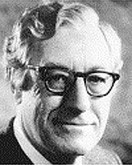
Digby Johns MCLAREN
Date de décès
2004-12-08
Date de parution
2004-12-14
Source(s)
Ottawa Citizen, ON
Texte intégral
McLAREN, Digby Johns Dec. 11, 1919 - Dec. 8, 2004 Digby Johns McLaren passed away at the Civic Hospital in Ottawa following a brief and rapid decline. As a noted Canadian scientist, few individuals have exhibited such a successful blend of scientific leadership and administrative ability, both nationally and internationally. One of the world's foremost authorities in the field of palaeontology, he has inspired scientists of diverse disciplines and coordinated their work to test hypotheses and resolve problems on an international scale. Born in Carrickfergus, Northern Ireland in 1919, he studied natural sciences at Cambridge before and after the war, completing his M.A. with first class honours and the Harkness Scholarship in 1948. During the war years, he saw active service as an officer with the Royal Artillery in the Middle East, European and Italian campaigns. He received a Ph.D in geology and paleontology from the University of Michigan in 1951. Digby joined the Geological Survey of Canada (GSC) in 1948, leading to a variety of fruitful and important research work in the Rocky Mountains and Foothills, the Mackenzie Mountains and the Arctic Islands. His exhaustive studies set the framework for the Devonian stratigraphy of Canada, and indeed for North America. By the late 1950s, his scientific reputation was well established and his leadership potential was recognized with an appointment in 1959 as the head of the GSC's paleontology group and, in 1967, as the first director for the GSC's new Institute of Sedimentology and Petroleum Geology in Calgary. In 1973, Digby became the 14th Director General of the GSC, and in 1981 the Assistant Deputy Minister of Science and Technology in the Department of Energy, Mines and Resources. Throughout his career, Digby was an active and influential participant in international science. He headed the Silurian-Devonian Boundary Committee of the International Union of Geological Sciences (IUGS) Commission on Stratigraphy from 1968-72, and was Chairman of the Commission from 1972-76. Under his leadership, the Commission on Stratigraphy doubled in size and set up sub-commissions in every geological system and working groups for every boundary between systems. He was a founder and later chairman of the International Geological Correlation Programme (IGCP), sponsored by IUGS and UNESCO. In the early 1980s Digby served on the Advisory Committee on Science and Technology in Society to the Director General of UNESCO, and ran two Dahlem Conferences in Berlin on Resources and World Development. In 1981 Digby joined the University of Ottawa as a Visiting Professor in the Department of Geology, while retaining responsibilities to the Department of Energy, Mines and Resources as Senior Science Advisor until 1984. In 1987, Digby was elected the 101st President of the Royal Society of Canada, and was largely responsible for revitalizing and expanding its role and scope. In particular, he successfully created a firm foundation for the Canadian Global Change Programme. Digby authored over 100 publications and maps in the fields of palaeontology, biostratigraphy and regional geology. Of particular note, he was one of the earliest proponents of the theory of mass extinctions caused by catastrophic meteorite impact, linking these ideas firmly to disconformities in the fossil record. He had the rare distinction of being both a Fellow of the Royal Society (London) and a Foreign Associate of the U.S. National Academy of Sciences, and had a distinguished service record as President of the Palaeontological Society, the Alberta Society of Petroleum Geologists, and the Geological Society of America. His contributions have earned him numerous accolades and honours including the Gold Medal of the Professional Institute of the Public Service of Canada for Pure and Applied Science in 1979; the Leopold von Buch award and Honorary Membership of the Geological Society of Germany in 1982; the Edward Fitzgerald Coke Medal of the Geological Society of London in 1985; and the Logan Medal of the Geological Association of Canada in 1987. He was elected a Fellow of the Royal Society of Canada in 1968, a Fellow of the Royal Society of London in 1979, a Foreign Associate of the U.S. National Academy of Sciences in 1979. He received Canada's highest civilian honour, as an officer of the Order of Canada, in 1987. Digby married Phyllis Matkin in 1942 (deceased 2003). They have two sons, Ian and Patrick, one daughter, Alison, and four grandchildren: Jamis, Margot, Liam and Miles. The family would like to extend their appreciation to the staff of the Ottawa Grace Manor who provided comfort and care to Digby. In lieu of flowers, donations to the Salvation Army Ottawa Grace Manor would be gratefully appreciated. A Celebration of Digby's life is presently being organized and will likely take place in Ottawa in the first half of February 2005. For those wishing to attend, please notify Patrick McLaren at patrick@geosea.ca. Published in the Ottawa Citizen on 12/14/2004.